'%3e%3cpath%20class='a'%20d='M662.846,1043.8l-14.75-10.817-14.912,10.936a15.981,15.981,0,1,1,29.662-.119Z'%20transform='translate(-632.011%20-1022.02)'/%3e%3cpath%20class='b'%20d='M704.176,1354.583l13.291,9.865a16.179,16.179,0,0,1-26.706.112Z'%20transform='translate(-688.094%20-1339.553)'/%3e%3c/g%3e%3cg%20transform='translate(40.433)'%3e%3cpath%20class='a'%20d='M21.61-179.726a26.985,26.985,0,0,0-8.211-1.5c-7.4,0-11.8,4.757-11.8,12.382,0,4.106,2.509,6.256,5.539,6.256a8,8,0,0,0,5.507-2.281l.424,2.053h5.213Zm-7.234,3.519-1.6,7.722a4.593,4.593,0,0,1-2.411.782c-1.173,0-2.02-.749-2.02-2.444,0-3.389,1.6-6.191,4.79-6.191A8.418,8.418,0,0,1,14.377-176.207ZM38-168.583a14.118,14.118,0,0,1-5.7,1.238c-2.216,0-3.519-.88-3.519-2.444a4.5,4.5,0,0,1,.1-.815,15,15,0,0,0,3.975.554c3.812,0,7.266-1.629,7.266-6.028,0-2.7-2.151-5.148-6.745-5.148-7.331,0-11.469,5.735-11.469,11.8,0,5.507,3.877,7.038,8.635,7.038a25.253,25.253,0,0,0,6.908-1.043ZM29.267-173.7a3.587,3.587,0,0,1,3.324-3.226c1.173,0,1.6.587,1.6,1.238,0,1.271-.945,2.085-3.291,2.085C30.473-173.6,29.886-173.633,29.267-173.7Zm31.248-6.028a27.108,27.108,0,0,0-8.113-1.5c-7.592,0-11.991,4.953-11.991,12.414,0,4.334,2.607,6.223,5.572,6.223a8.258,8.258,0,0,0,5.6-2.281l-.1.815c-.326,2.737-2.542,3.486-4.985,3.486a22.6,22.6,0,0,1-6-1.01l-.978,4.985a31.974,31.974,0,0,0,6.843.847c5.441,0,9.775-1.792,10.948-7.69Zm-7.234,3.552-1.531,7.69a5.239,5.239,0,0,1-2.574.782c-1.173,0-2.02-.782-2.02-2.379,0-3.454,1.4-6.223,4.725-6.223A7.013,7.013,0,0,1,53.281-176.175Zm10.362-4.659-2.476,12.349c-.717,3.617.652,5.865,4.464,5.865a25.851,25.851,0,0,0,3.747-.293l.782-4.334c-2.281.033-2.542-.912-2.216-2.574l2.281-11.013Zm7.82,13.1-1.075,4.822a39.953,39.953,0,0,0,6.289.489c5.7,0,9.775-2.313,9.775-7.331,0-5.474-7.4-3.877-7.4-5.637,0-.652.619-1.14,2.607-1.14a23.311,23.311,0,0,1,4.79.554l1.108-4.659a29.486,29.486,0,0,0-5.735-.586c-4.985,0-9.58,2.118-9.58,7.136,0,5.311,7.4,3.78,7.4,5.409,0,1.108-1.173,1.5-2.867,1.5A29.214,29.214,0,0,1,71.463-167.735Z'%20transform='translate(-1.604%20187.383)'/%3e%3cpath%20class='b'%20d='M614.561-237.057h6.712l.945-4.79h-6.712Z'%20transform='translate(-552.294%20241.847)'/%3e%3c/g%3e%3c/svg%3e)
Until now, the numbers in Aegis came one month at a time. That's enough to see a trend, but it hides the day a video took off, and it says nothing about where your viewers are or what happened to a claim after Aegis made it.
Three new views fill those gaps. They use the same data Aegis already collects for your claims, and they update every night.
Your views, one day at a time
Open your Dashboard and pick the Views tab in Stats overview. A switch appears above the chart: Monthly, as before, or Daily · 30 days.
The daily chart shows the views your claimed content got on each of the last 30 days. Under the chart, Aegis names your best day ("Peak: 13.64K views on 10 Oct 2026") and says when the figures were last updated.
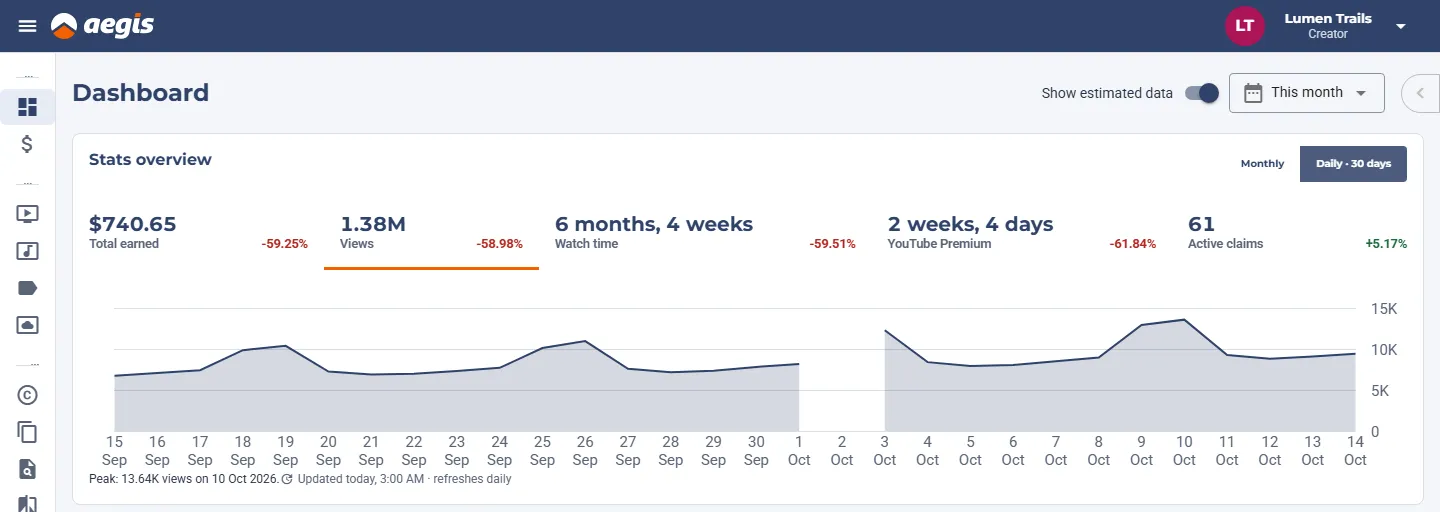
The daily chart for a fictional creator. The figures are made up.
A few things to know:
- Gaps are on purpose. The daily figures come from YouTube's daily report. When YouTube hasn't delivered a day yet, or skipped it, the chart leaves a gap instead of drawing a zero. A drop to zero would look like your views stopped, when really the number just isn't there.
- Daily figures start on 22 August 2026. That's when YouTube's daily report begins for Aegis. Earlier months stay monthly.
- The switch is for views only. Earnings, watch time and claims stay monthly, because that's how YouTube reports them to Aegis.
The daily view is useful after an upload, a collaboration or a video going viral somewhere. You can see the day it started and how long it lasted, without waiting for the month to end.
Where your views come from
Open Asset statistics and scroll below your assets to Views by country. Pick a month, and Aegis shows how many views your claimed content got in each country that month.
The ten countries with the most views appear as bars, with their views and their share of the total. Every other country is listed in a table underneath, with its views, watch time and share. A country YouTube doesn't know shows as Unknown.
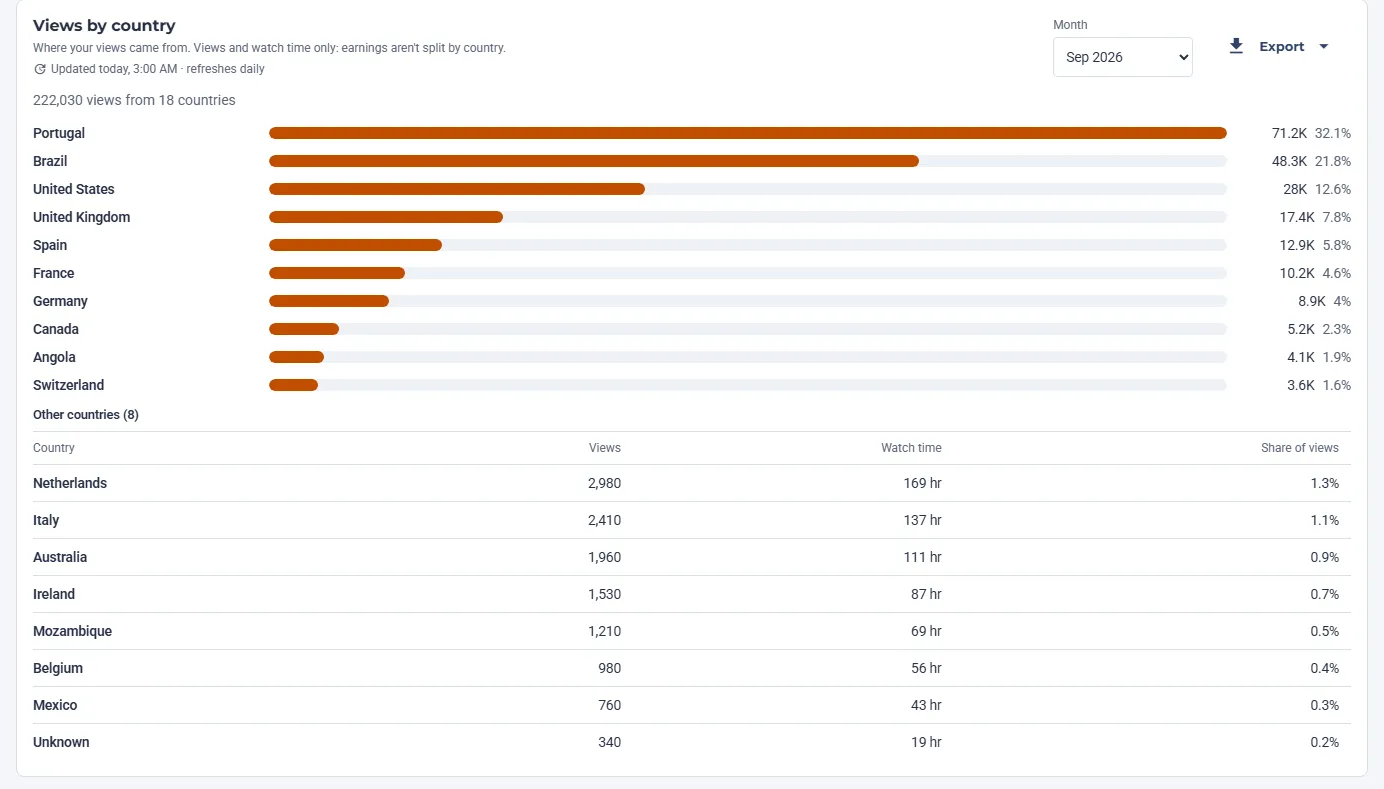
Views by country for a fictional creator.
Country figures start on 22 August 2026 too, so August 2026 is a partial month and the page says so. The section shows views and watch time only. YouTube's revenue report doesn't split earnings by country, so Aegis can't either, and we'd rather show nothing than a guess. Export downloads every country for the month as a CSV file.
Knowing where your views come from helps with simple decisions: which language to add subtitles in, what time to publish, or whether a country you never thought about is watching more than you expected.
What happened to your claims
Open Claims. At the top there's a new section, Claim outcomes.
It shows the claims made in each of the last six months, split by what happened to them since:
- Active: the claim is in place.
- Disputed: the uploader disputed it.
- Appealed: the uploader appealed after a dispute.
- Released or ended: the claim was released, became inactive, ended in a takedown, or is pending.
Show as table gives you the same numbers as rows, with totals. Export downloads the months, or the content list below them, as CSV.
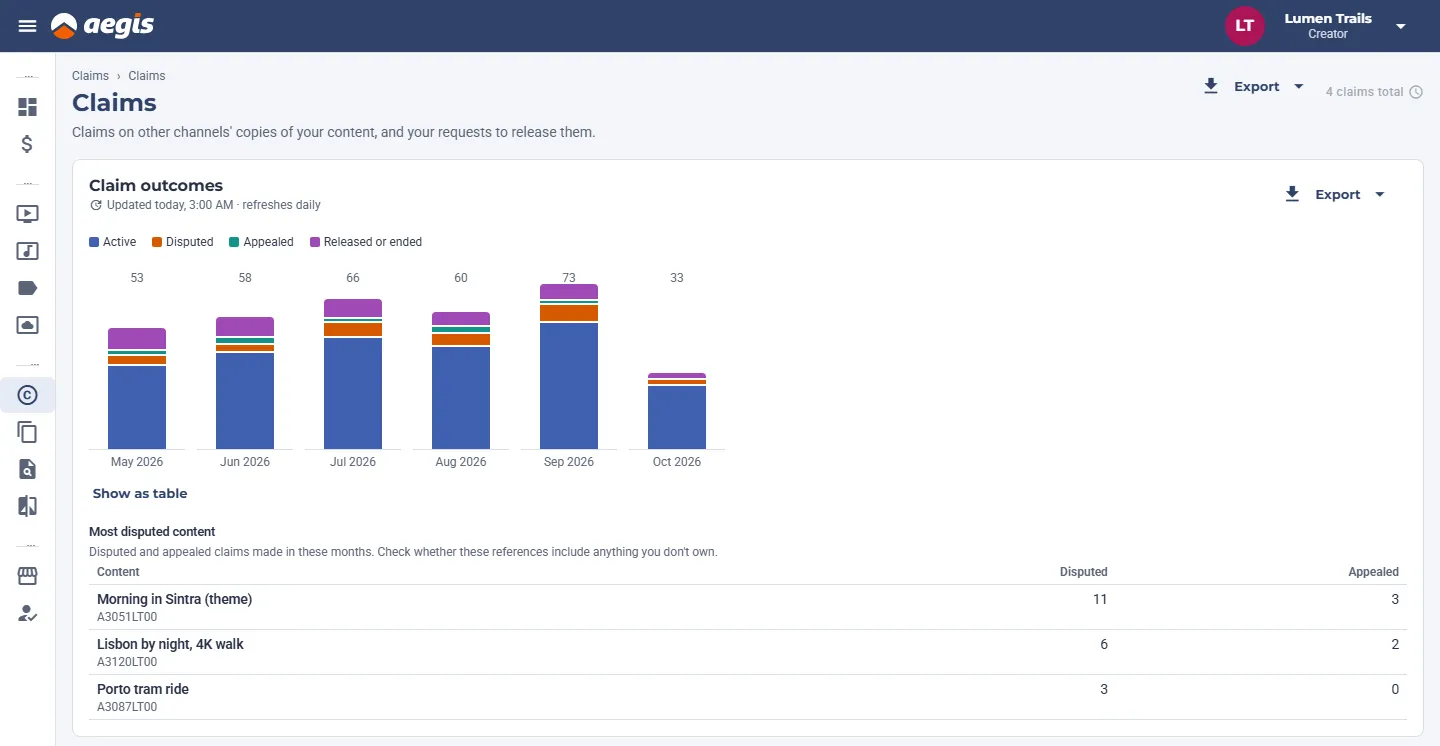
Claim outcomes for a fictional creator.
Under the chart, Most disputed content lists the content with the most disputed and appealed claims in those months, up to ten. If one asset keeps getting disputed, check its reference. It may include music, clips or footage you don't own, and claiming those puts your account at risk. Our post on checking whether your content qualifies explains what Aegis can and can't claim.
The page counts disputes but doesn't show the reasons uploaders gave. Aegis's claim sync doesn't receive them, so we can't show them yet.
When the numbers update
All three views refresh every night, and each one says under its title when its data was last updated. YouTube's figures usually arrive a few days late, so the most recent days and the current month fill in over time.
If you manage creators, the agency side of these numbers is in our post on running your roster in one place. And to see the channels re-uploading your content, read who is using your content.